Pages

Tuesday, January 12, 2016

cdcd and Next Gen Love

banner for cdcd etsy shop: old photo of three men on bicycles


I can't claim that 2015 was a very successful year for me on the blogosphere. After a couple of months of trying to find a balance between themes of reading, sewing, gardening, and general domestic feats, I quickly became distracted by Instagram, its ease of updating, and its browse-ability. My daughter became more aware of the world around her, and consequently, the time during which I could plug away on my phone became limited to her sleeping hours. When fall came I wanted to newly commit to the blog, but found myself in one of those periods of time where you lose someone dear to you, and you feel your life changing. In October I started the process of trying to redefine life in this new world without my father, a process which I imagine will continue for years.

Dudszus family selfie picturing father, daughter, motherSeveral years ago I opened an Etsy shop under the name cdcd, which stood for "Canadian Dad, Canadian Daughter." While the shop itself never made a sale and rarely had any listings, I am still satisfied with the concept behind it. The name, a private poem to myself, was motivated by the shifting meanings that evolve from one generation to the next, whether referring to the life of a good (such as a physical thing), or a person. While my father was born in Germany and would fondly refer to Koln as "home," there were many elements of his personality that made him more Canadian than German. Although I called him "Papa" instead of "Dad," and he only obtained his Canadian citizenship within the last 10 years of his life, his immigration and our relationship embraced the casual attitude that helps Canadians define themselves as they wish, rather than adhering to pre-defined traditions that lay out the way things "should be." For the store, my concept was to reuse discarded materials to make new products, such as books into journals, which is an obvious regeneration of the old into the new. Sometimes the old into the new doesn't actually involve a physical transformation. Generations shift. For the banner, I was able to use a picture of my father and his friends from Germany, before he immigrated in the 1950s.

As I continue to read, sew, garden, and attempt to manage their competing time constraints on domestic life, I will be moving this blog to another location, which may or may not manage to capture some of these same connections. While cdcd quietly awaits further direction, I will be moving the blog over to NextGenLove.ca within the next few weeks. I hope to steadily document some of the changing ways I live within my space, and with my family, in 2016.

Tuesday, September 22, 2015

Canning Pressure

The funk that seems to have settled over my gardening activities has similarly affected my canning this year. I had been imagining jar upon jar of home grown produce, lining the shelves of our rarely used pantry. Move over old Costco snacks, I would think. Here come the jars.

jars of canned produce and croc of pickles

But this year has been an absolute downer for the garden. Tomato planting was postponed while a second garden terrace was built, so we have only had a handful ripen on the vine this late in September. Last year's garden terrace was planted with beans, broccoli and cabbage, but I soon found it was home to an aggressive ant colony, determined to keep me from weeding at all costs.

And the animals. My beans, kale and broccoli were all chomped off at the stem. This was particularly disheartening, as we terraced the south side of the house specifically to plant veggies there. The backyard was deemed too much of an "animal zone," but I felt the side of the house had shown little evidence of furry friends. Surprise: you plant veggies, and the animals will move. New animal scat appeared daily, deterring me from spending time out in the garden with my newly mobile daughter.

So while I wait for my tomatoes to finish ripening, I have been buying 10 pound baskets at the market, and canning small batches. I have tried fermentation, a new and somewhat frightening experiment for me (is it done? is it safe?) I want to buy the bushels. I feel like I should be able to handle the bushels. But this year, I just can't. The babe rarely allows me ten minutes alone in the kitchen, never mind the time it would take to can a whole bushel of tomatoes. So even though those large ripe baskets of farm fresh produce are beckoning me, I'm holding firm to my resolution to can when I can, and forgive myself if I have to buy a jar or two.


Tuesday, July 28, 2015

Mid-summer Flakiness

It has become increasingly hard to sit down and write in this beautiful summer weather, something I haven't experienced to its fullest in a few years. When our days are filled with swimming, hiking, avoiding gardening, and enjoying our messy backyard, the short time between little one's bedtime and my own is usually spent calming the tide of housework that threatens to overflow on us, and occasionally reading a bit before lights out. So if you're reading this, my apologies for the lack of new posting. I will get better soon, I promise.


Saturday, July 18, 2015

Garage Sale Love


Because although I want to learn smocking to make a beautiful hand smocked dress for baby, I really don't have the time/space/patience to learn another craft. So these beauties came home with us from the Whispering Hearts Garage Sale.


Friday, July 10, 2015

Brantford Villages - Hard Core Volunteering

A year and a half ago I was finishing up my Master of Library and Information Science degree, and took a course on "The Creative Economy." One of my assignments in this course was to report on a festival, and so I developed this short video about the Brantford Villages. The video is about 8 minutes long, and looks at how the festival shares and celebrates traditional knowledge (aka information).


Brantford Villages from Erica Dudszus on Vimeo.

It gets a bit dry and library-science-y around the 3 minute mark, but in summary: as a result of many, many volunteers, the Brantford Villages continues to create a really unique representation of the changing local immigrant culture. Although the dances and programs may be similar year after year, the experience of the Villages is one that goes, for the most part, unrecorded, undocumented.

The focus of this report was information, which in this context was the traditional cultural knowledge shared and displayed at the Villages. What wasn't relevant to the report, but that I feel very strongly about, is that this truly amazing festival is made precarious by its total reliance on volunteer labour and non-annualized grant funding.

The coordinating committee of the festival puts in an insane amount of hours. The treasurer, secretary, villages chair - none of these are paid positions, though they are responsible for chairing numerous meetings, meticulously reporting attendance and volunteer efforts to funders, and securing grants so the festival can run for yet another year. Also putting in many hours are the coordinating members at each club. I know people that used to regularly take two weeks off work for the Villages, which obviously leads to burn out. Unfortunately, working volunteers beyond the time they can reasonably contribute doesn't make for a healthy organization, which is a problem that many organizations participating in the Villages face on a regular basis, not just at this time of the year.

While I almost always hear unequivocal praise from festival attendees, I think the volunteer efforts should be more widely acknowledged - what they have accomplished for decades is absolutely astounding.

Tuesday, June 16, 2015

My orientation to babywearing

Over the last two months I have been learning about babywearing. At first, I didn't really understand why the act of using a baby carrier, sling or wrap needed its own name. I came to learn that the name babywearing represents not only the act, but also the babywearing community, where people share knowledge and the actual carriers themselves. There are many resources out there telling you why you should wear your baby - I am not going to add to these. However, I would like to share my learning experience, in hopes that it might assist someone new to babywearing.

Looking for an alternative to our Baby Bjorn, I found my local babywearers group, attended a couple of meetings, and borrowed a few different carriers from their lending library. I joined the Canadian Babywearing For Sale or Trade Facebook group and browsed the sales for a few weeks, cross-referencing prices with those of retailers. I found the market for carriers quite confusing, and was surprised to find most didn't depreciate in value much, if at all - some actually rose in price.

I decided I wanted both a soft structured carrier, as I had become accustomed to how convenient my Bjorn was, but it was starting to hurt my back with baby's increasing weight. I also wanted a woven wrap, as I liked its flexibility (so many types of carries with the same cloth), and had used a stretchy wrap when baby was wee.

Soft structured carriers (SSC) generally buckle on, and are relatively easy to use. They might be made from a wrap (wrap conversion or WC), which likely means they are softer and have a nice pattern, though these generally cost more. SSCs allow you carry your baby facing you, and most allow you to carry your baby on your back. When buying, look at the types of carries the SSC can do, ergonomics, fit, and weight limit (some do infant to toddler, some companies make multiple sizes). Style may be important to you as well. We own a Manduca, and a Baby Bjorn. The latter isn't as widely promoted in babywearing groups, likely because its standard option is not ergonomic. I use our Manduca for grocery shopping, and when I want to get baby up quickly and securely. I'm not experienced with back wrapping, so it takes some time and patience - both of which are in short supply when babe is crying or fussy.
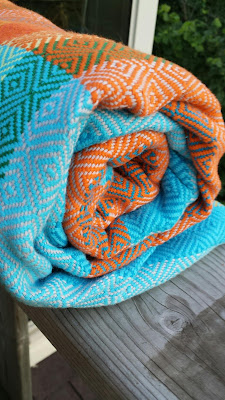
my Turkish Towel wrap - big diamond weaveWraps can be stretchy or woven, the latter being the generally more preferred amongst babywearers because they continue to be supportive once your baby isn't so tiny. Stretchy wraps are good for newborns (also referred to as "squish" - my FAVORITE lingo from babywearers!), but cannot be used for back carries. There are also hybrid wraps with some stretch in them, but I am completely unfamiliar with these.

Woven wraps are made with natural fabrics such as cotton and linen (which are breathable), come in different sizes, and are tied in specific ways to support your baby. With each size you can do different carries. Longer isn't always better. Some wraps need "breaking in" before they tie easily, depending on the material and weave. When buying, look at what size you would like, how supportive you would like the wrap to be (ie. thicker or more durable fabric supports larger children), how easy you would like it to be to wrap with, and - very important - appearance. Ultimately, I decided to buy a new handwoven wrap, a Turkish Towel size 5 that I picked up on Etsy. The price range for these is similar to a higher end machine woven wrap, so quite good for a handwoven. I spent some time looking for something I really liked at a reasonable price, and I'm not too concerned about reselling it as I'd like to use it for as long as possible. We have also used a Boba stretchy wrap.

I know very little about mei tais, which are similar to soft structured carriers in that they have a square of fabric for the baby to sit in, and straps extending from it to wrap around the person carrying the baby. This carrier is also very lightweight, but seems like it would be a bit more convenient to use than a wrap. Similarly, I am not familiar with ring slings, which use rings to tighten the wrap around you and the baby. They also seem lightweight and convenient. Babywearing groups generally have both of these types of carriers available in their lending libraries.

As with any community that is built on knowledge sharing, there tends to be a lot of lingo, a serious learning curve for newbies, and the occasional person who might come across as a know-it-all. My initial experiences with the local group could have been intimidating if not for some friendly and helpful group facilitators. While the learning curve will seem steep, there are plenty of resources to help you on the way:

1. Your local babywearing group. Find it (Canadian groups here) and attend a meeting, where people can help you wrap and lend you carriers.

2. Facebook swap pages and retailers. Research prices, research weaves. Look at everything to figure out what you really want. Serviceable, stunning, or somewhere in between? Wraps can range from roughly $80 to several hundred (or even a thousand) dollars. Be prepared to see some beautiful things. Do not be surprised to see some very expensive things.

3. Make sure you are following safety precautions. Your babywearing group will be your number one resource for this, as they can observe and help as you put your baby into a carry. This site visually reviews optimal positions for all types of carriers.

4. How-to wrap videos are also indispensable. Watching the same wrap performed by different people can shed some light on what works best for you. My favorites are Wrapped LifeBabywearing Faith, and Wrap you in Love.

I started learning about babywearing to "get more stuff done," but find that wearing is soothing to both baby and myself. I'm no expert, and still have a long ways to go before I can comfortably throw little one up on my back and wrap her. We practice, I fail sometimes, we try again when we are both in a better mood. With wraps playing nicely into my love of fabric, my goal is to resist developing yet another massive stash - no matter how much handwovens, fantastic colours, or beautiful designs tempt me. And this is something you may learn: buying carriers and wraps can be addictive.

This is the first post that I am going to promote in any public way (heart thumping). I know this isn't a comprehensive review of babywearing - it isn't meant to be. But if you have any thoughts, please let me know!

Monday, June 08, 2015

Canning for a New Generation - Review

Although it doesn't seem very timely to be reviewing a book published in 2010, fresh produce is nearly upon us! I have started to pull my canning titles off the shelves after their winter hibernation, and Liana Krissoff's Canning for a New Generation was the best place to start. Having used this for two seasons already, I have found this book a pleasure to read and cook from.

For me to purchase a cookbook, I need to know that it contains more than a handful of recipes I will use; furthermore, it should teach me something new about working with food. This book falls strongly into the latter category, though I have tried several recipes from it each year with great results.

Krissoff's approach to preserving is actually very traditional. She avoids commercial pectins by straining and boiling down her product, working with with the pectin content naturally available in the fruit and amending it as necessary. This makes for lovely, flavourful preserves, even if they are a bit time consuming. For the total newbie, she thoroughly goes over the various aspects of canning, providing some rarely seen detail about your pectin options. For the more experienced cook, her recipes are at once classic and innovative, each jar presented in tantalizing photography. She has something for everyone, including the "new generation." Will your friends stare blankly at a jar of strawberry preserves? Maybe these friends might be more impressed with one of the book's more ethnic options, such as Persian Tarragon Pickles or Japanese Fermented Bran Pickles. Ooooo. Food cart-y.

Inter-dispersed among the recipes for canned goods are recipes in which you can use them, which I typically don't like to see. Let canning books be about canning, I would say. For this book, however, these are sometimes quite necessary. I might make Do Chua (Vietnamese Carrot and Daikon), but how will I use it? Krissoff tells me, and clinches the deal: her "Asia Tacos" look delicious. I planted daikon this year. Furthermore, the narration in this book is so engaging I was surprised to find how much I liked the personal voice and anecdotes she carried through the recipes. She won my trust, and for that, I will try her scones (or rather, Reagan's scones).

Canning for a New Generation - Krissoff's pantry
Krissoff's pantry (Canning for a New Generation Facebook page)
The book's Facebook page is well maintained. Krissoff carries on excellent dialogue with her followers, and displays some mouth-watering shots of her preserves.

On my "must make list" this year? I am hoping to start her Pickled Young Spring Garlic recipe by the end of the week, to help my desperately overgrown garlic patch. Last year's batch of apple butter is nearly exhausted, and from the looks of things at the market so is last year's apple harvest, meaning that I suspect we will be picking up cheap butter-grade apples again soon. And I will absolutely be making one of her strawberry jams or preserves, and something with rhubarb. For a start.

Wednesday, June 03, 2015

The life changing magic of tidying up: review

In the midst of feeling completely overwhelmed by all the stuff in our house, I heard of this title, published last year in English (translated from Japanese): The life changing magic of tidying up, by Marie Kondo. I jumped on the holds list at the Brantford Public Library when it was only a few people long; now there are almost 20 in line behind me.

the konmari method of tidying - book reviewI'll get right to the point: reading this book was a good experience for me. Entertaining, thought provoking, and very likely useful in helping me to keep a better house. At the beginning I was a bit shocked at Kondo's obsessive behaviors. As I read on, I became impressed that she made herself so vulnerable by sharing these things. I found the book very readable, and wasn't turned off by some of the zanier suggestions she makes, such as communicating with your house or thanking possessions for their service to you. I am fine with these things.

I respect that Kondo sticks to her mission, in focusing totally on tidying and discarding (the latter of which is really the main event). In its directives, the book is very simple and I don't think I will have problems following the instructions even after I return it to the library. However, I think she does have a blind spot; there is a lack of comment on responsible disposal of your discarded stuff. If you slow down to recycle and re-home goods, will it impede the discarding process? Possibly. She doesn't discuss this. While she is impressed with the number of garbage bags that her clients discard, I cringe at the thought of throwing out 60 bags at one go.

Donate it, you may say. While I do use trips to the thrift store as a way to destash, I often feel like this is making my garbage problem someone else's problem. You may be aware that unsold thrift store goods are sometimes donated or sold in developing countries, where in some cases they may be supplanting local textile industries. Eek. What started as a way to be environmentally friendly - recycling your clothes - can have a whole other set of consequences for people in southern countries. Value Village states on its website that they ship unsold product to "developing countries to help supply economies with a steady stream of high-quality goods." However much negative impact this has at a local level I am unsure of, but it makes me wary. What about locally made products? I haven't ever thought of my used t-shirts as "high-quality goods".

But really, is my problem with disposing of things in a manner that I feel comfortable with Marie Kondo's problem? No, not at all. She stays on topic. While certain things in this book don't feel realistic (turning over a seasonal wardrobe is fairly important in a country where temperatures spread over 60 degrees Celsius, for one), I also believe that things hold an energy, and that having too many things often means you don't get to appreciate the ones you have. There are many Konmari before and after pics out there, but this set from the New York Times is particularly good, I suspect because it shows a room Marie Kondo worked on herself. I'm not ready for before and after pics yet, but I do think I will start with getting rid of some items. Once I figure out where to send them.

Friday, May 29, 2015

Shorts for the week

I don't remember watching the original airing of the season of Friends where Chandler seems to gain 5 pounds and then lose it again every other episode.

When did we stop caring about aluminum in deodorant?

Walked behind McDonald's carrying the babe. She started coughing from the McStank.

Thinking now that it is shower-every-day weather, I am screwed.

Thursday, May 28, 2015

Writing on a time budget

Since going to Toronto at the beginning of the month, my blog activity has dropped off. The two week break took all my steam away; I don't approach my posts with the same excitement as I did a month ago. Part of this, I feel, is a lack of focus with the topics I am covering. At the moment I am passionate about gardening. Our new kitchen means more cooking. And of course the baby, who is the most exciting thing in my life, always. Too many adventures, but perhaps not enough of any of them to classify this as a gardening, knitting, crafting, cooking, reading, or mommy blog. And to focus on one - and the requisite online presence in that area - would require giving up time devoted to those other hobbies.

To that end, I am going to reduce my posting goal from three posts to one quality post per week. Since I haven't widely publicized this blog, I feel like I am writing this to a bit of a non-dience, who in their nonexistence will not care if I do not write, or if I cease to write about their topic of choice. If I am wrong about this, please let me know.

I hope to update my About page shortly with my other online coordinates.


Tuesday, May 19, 2015

BBQ Ribs

Ted Reader is my go-to for BBQ recipes. He celebrates good, rich, barbequed food, and following him on Instagram or Facebook will seriously inspire you to grill something. So when ribs went on sale before the long weekend, I decided to try his back rib recipe from Everyday Gourmet Grilling.

Horrible picture, delicious ribs.

I always BBQ my ribs. While there are a few different ways to do it, I give them a good rub with something and letting them sit for awhile, then put them on the grill low (around 325) and slow (for at least 2 hours). Turn on one side of the grill and place the ribs on the other, with a drippings pan underneath. My ribs tend to take a bit longer than the recipe calls for, probably because I open the lid far too many times - usually to add other items to the grill. Sunday evening I also grilled sweet potatoes and baked some brownies on the BBQ.


I also treated myself to Ted's Thai Chili Lime Coleslaw, a recipe I have been wanting to make since I got the cookbook. I made a few omissions: didn't grill the pineapple, didn't add the chili (I know this is nearly unforgivable), and didn't add the rum. Yep, you read right: no rum in this coleslaw.


Friday, May 15, 2015

May Garden Pics

Working on the Instagram photo challenge hosted by Sweet Domesticity, I caught this shot of my thyme one evening:

A photo posted by edud5 (@edud5) on
I once read that to get the best shots of your garden, you should try getting out first thing in the morning, or last thing before the sun sets - this one was taken at just the right time.


Wednesday, May 13, 2015

Book sale haul

One of my favorite events of the year is the Brantford Symphony Orchestra book sale, which happens every April. Book donations are collected and sorted for weeks before the sale, and it is fair to say there are thousands of items. This year's venue was the closed Brantford campus of Mohawk College, but it has also been hosted at closed factories and schools.

Books are priced between 50 cents and roughly 5 dollars, though there are plenty of 25 cent finds and the rare book that costs more.

This year I arrived within half an hour of opening. I was so excited I could hardly stand to park the car; I wanted to run inside, to stop people from getting to my wonderful book deals. In addition to very keen readers, opening day is also marked by dealers pushing around shopping carts filled with books, with boxes of more books piled on top.

book sale haulThis year I walked away with 16 books, 5 patterns and a tape of awesome hits from the early 90s for $28.50. That is about 10 dollars more than I usually spend, but this year I started looking at the 3 and 4 dollar books (which I usually set aside because of their "high price" and then regret this foolishness when I get back home).

Please don't judge me for the Twilight books - as an MLIS holder I consider it a kind of research to read the YA smash hits.
cheesy Kwiksew pattern

Though I am very excited about my patterns, my favorite score at the book fair was a beautifully laid out Audubon bird book. I have been looking for an affordable source of Audubon prints for our living room, and this book almost appears to be made for it - one picture per page,  high quality paper. If I can bring myself to cut it up.

Sunday, May 10, 2015

The spring thing

I took a break from blogging during our kitchen reno, as we lived out of our car until my cousins in Toronto warmly welcomed us. Now that we're back it is obvious spring has overcome this small town.

Looking forward to writing more as daylight extends.

Wednesday, April 22, 2015

Granola bars vs. Lemon buns


Yes, I will eat you granola bar. But I am not going to enjoy it.

Ok, I will enjoy it. But not as much as I would have if I wasn't limited to what was available in my cupboard, baked in the spirit of "use it up." Based roughly on Sprouted Kitchen's recipe, minus the dates, plus raisin paste, wheat germ and hemp seeds.

But you! I am going to love eating you, you delicious sticky lemon roll.

Made using the Kitchn recipe, but in a bread machine using the dough cycle. I reduced the yeast to 1 1/2 tsps, and probably should have reduced the flour to 3.5 cups. I had to hand knead it at the end of the cycle, as not all the flour had worked in to the dough. I let it rise an extra time for good measure.

Tuesday, April 21, 2015

The Ornamental Vegetable Plot

garden June 10 2014
I can't recall where I first heard of potage gardens, which have now become a source of inspiration to me. Books on the subject and it's related subjects - potager,  kitchen gardens, ornamental vegetable gardens - are the ones I turn to most for developing my garden plans. After inheriting some very high-maintenance gardens with the purchase of our house 3 years ago, I have slowly started to convert the beds to be 1) more easily maintained and 2) able to produce food.

garden June 27 2014Nowhere on our property is there a chunk of land eligible for the perfectly rectangular veggie bed that I grew up with, so I had to get creative. Our house backs on a river, making the backyard a regular wildlife sanctuary. Yes, groundhogs. Yes, deer. Yes, fluffy bunnies. I decided that it would be better to grow food closer to the house, as the larger, hungrier animals tend to stay "down by the river." However, this means working with oddly shaped beds, and ones that are already occupied (overtaken, in most cases) with perennials and even some wildflowers. And serious weeds. Eek.

So I started the conversion with the least populated, most rectangular bed, a front bed that lines our driveway up to the sidewalk. While formal French potage gardens require fairly large spaces to incorporate their geometric layouts, I simply tried to make a "pretty" veggie plot, incorporating some patterns into planting and including flowers throughout. I planted radishes, cabbage, kale, beets, and runner beans with nasturtiums, marigolds, borage, and ageratum, which was completed buried under the foliage from nearby cabbages. Tomatoes reseeded themselves from last year and I was literally pulling them like weeds. By the dozen.

garden July 11 2014
These pics show the garden shortly after planting on June 10th, on June 27th, and July 11th. I clearly tried to squeeze too many plants into the bed. But that is kind of my style.

I try to take road traffic and potential pollution from passers-by into consideration when planting. While it seems wonderful in theory to grow food on your front lawn, you don't want dogs to water your lettuce. For this reason, much of this front bed was planted as it was purely because I liked the look of the plants, and as a growing experiment; I was hesitant to harvest much leafy growth from a road-side location. This year I am going to try to push back the edible plants even further from the road by moving more blooming perennials to the front of the bed, and will try to find another location for my leafier plants.

Tilling near bulbs isn't practical, meaning most perennials don't mix well with annual food plants. In the top most photo, you can see two bean tee-pees; I roughly allotted the space in between them for tilling and vegetable growth. However, easy grow annuals that don't need much tilling can easily by set amongst your perennials to add a decorative effect - I personally love nasturtiums.

Though this bed wasn't a total success, I did learn some things about what thrives in it and what doesn't. And most importantly, the bed is better organized for growing this year.


Friday, April 17, 2015

Can't get enough of that butterfly weed

I didn't manage to snap as many garden shots as I had hoped this week, partially due to a cold. Partially due to the constraint of shooting pics with a wiggly 16-pounder strapped on to my chest. While enjoying the sun this week I have also been fighting off a cold.

I did like this shot of butterfly weed reaching for the light.

A photo posted by edud5 (@edud5) on

I had no shortage of seedlings posing for the job, but the photogenic butterfly weed stole the show again. After weeks of cool weather, this is a delicate time for seedlings, even indoors, as they can quickly get dehydrated. I almost lost some bloody dock this week to dehyrdration, their stems so spindly that their tired leaves lay on the soil in defeat. Yikes. Gotta be a better seedling mama.

Seed starting

Since moving to this house three years ago, I have very enthusiastically been starting my own seeds in our sunroom.  Growing from seed is satisfying, gives you many more varieties to chose from than are typically available locally, and is theoretically cheaper than buying seedlings.

Theoretically because I tend to go bananas at the seed store.

Currently I have 6 flats and a few miscellaneous containers of seed started,  and I will likely start 2 more flats. I am not in any particular rush to get things started, as the increased daylight further into spring helps seedlings grow in a less spindly fashion.

While most of my seeds are started in the pots you see pictured, I am also trying some tomatoes sewn in a larger container (a pre-washed lettuce container from the grocery store). I babysat my mother-in-law's seedlings last year and they performed beautifully in that kind of setting, I think because of the larger amount of medium they could draw nutrients from, and the added moisture that medium retained.

Although I enjoy watching all my veggie seeds grow, and I like trying out new annual blooms, I love growing tomatoes. Love. Love. Love. In addition to the lettuce container, I seeded a flat of tomatoes on the weekend, including some Sicilian Saucer tomatoes from William Dam. Last year I tried to encourage my friends and family to compete with me for the title of the biggest Sicilian Saucer tomato, but no one adhered to my astringent reporting regulations, despite good reporting yields. I look forward to seeing whether someone takes my title.


Wednesday, April 15, 2015

Baltic un-Birthday Bread

One of my favorite treats to make for a party is a Baltic Birthday Bread, from this super duper Canadian-flour bread machine book. It looks very impressive, and I consider myself somewhat Baltic in origin, as my father's family comes from the former Konigsberg. While that particular region of the Baltic has, and had, little cultural similarity to Estonia, Latvia, and Lithuania, I still am drawn to Baltic culture. I am not sure how authentically Baltic this is, but I did find another recipe for it citing Estonian origins.


I simply couldn't get a picture of it whole. It is that good.

While I technically made this to clean out the cupboards (it uses sliced almonds, candied fruit, and saffron), the only reason those ingredients were in the cupboard were my aborted attempts to make it over the last few months. The texture and flavor is reminiscent of hot cross buns, soft and doughy with hints of fruit.